
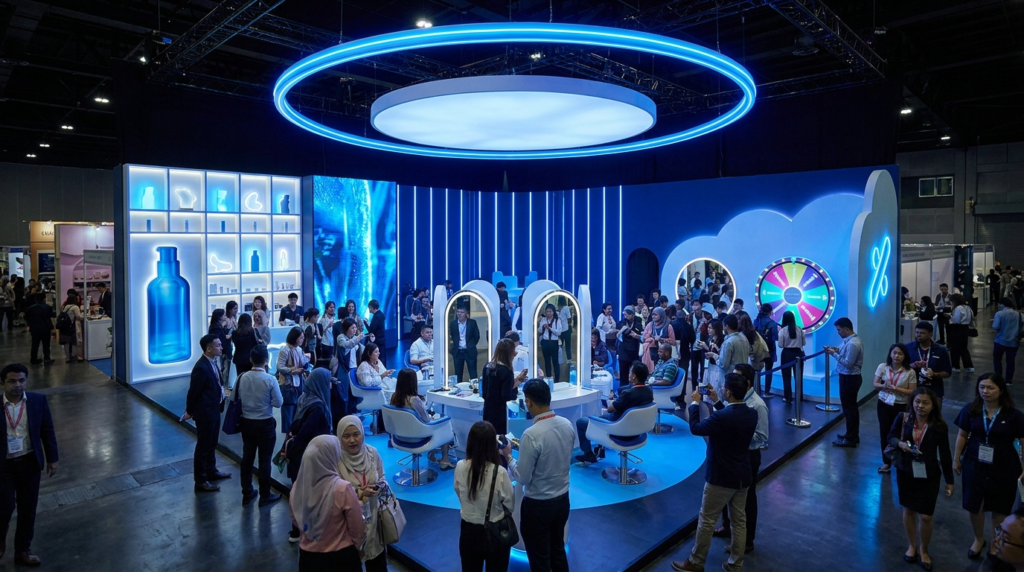
On a busy show floor, you have about three seconds. That is roughly how long an attendee’s eyes rest on your stand as they walk past, phone in one hand, lanyard in the other, already scanning for the next thing worth their attention. Get those three seconds right and you earn a conversation. Get them wrong and you have paid five figures to become wallpaper. Closing that gap between a glance and a conversation is the real job of any event planner in Singapore, and it is won in the design long before the doors open.
This is the uncomfortable truth behind exhibition booth design in Singapore: a beautiful booth and a busy booth are not the same thing, and only one of them justifies the cost. The stands that pull a crowd are rarely the most decorated. They are the ones engineered around a single question, which is how to turn passing foot traffic into a meaningful interaction. Whether you build the stand in-house or bring in an experienced event organizer in Singapore, that question should drive every decision before aesthetics enter the conversation.
Why Most Booths Get Walked Past
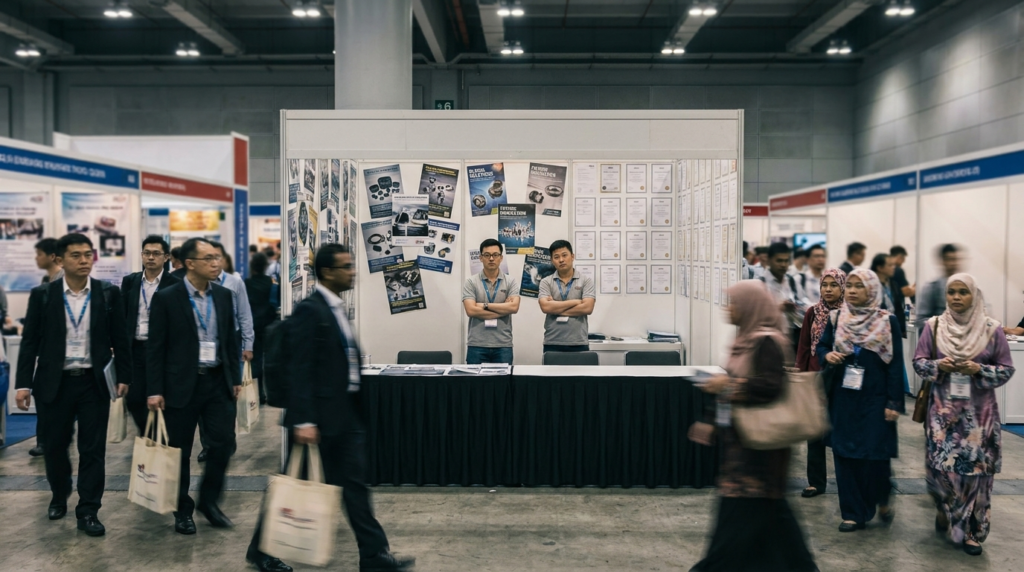
Ask any seasoned event planner in Singapore why a polished stand still sits empty on the day, and the answers are remarkably consistent. Walk through any major exhibition at Singapore EXPO or Suntec and you will see the same mistakes repeat across the hall:
- Clutter. When a booth tries to say everything, it says nothing. Five product lines, three taglines and a wall of certifications all compete for the same square metre, leaving a passer-by with no idea what you actually do.
- The fortress problem. A long counter placed across the front, with staff stationed behind it like a reception desk, reads as a barrier rather than an invitation.
- A missing focal point. Without one clear, high-contrast message that registers from a distance, there is nothing to catch the eye mid-stride.
None of these are budget problems. They are design-thinking problems. A stand built to photograph well is optimised for a camera that stands still. A stand built to win foot traffic is optimised for a distracted human moving at walking pace, spoilt for choice.
Start With Foot Traffic, Not Decoration
The best stands are planned from the floor up. Before anyone discusses colours or finishes, settle how people will move around and into your space.
Read the Hall Before You Design the Booth
Your booth never exists in isolation. It lives inside a traffic system, so the position of your lot shapes everything:
- Where you sit relative to the entrance, registration, F&B and the keynote stage.
- The direction the crowd naturally flows.
- Whether you have a corner, an inline lot, or an island with exposure on all sides.
A corner or island gives you two or more open sides, so the design should pull people in from multiple angles. An inline stand sandwiched between neighbours has to work harder vertically and at the front edge, because that is the only surface most people will see.
Arrival direction is the detail most teams overlook. Visitors usually enter from one or two main doors and move through the hall in a predictable pattern, often drifting in one direction before doubling back. If most of your traffic approaches from the left, the message and entry point should face left, not sit politely centred. Spend twenty minutes studying the floor plan and the previous edition’s photos before locking the design, and you will place your strongest visual exactly where the most eyes will land.
Design an Open, Walk-In Booth Layout
Once you understand the flow, design a booth layout that behaves like a magnet, not a gate. A simple working rule:
- Keep the front 60 percent of the space open and welcoming.
- Reserve the back 40 percent for demos, meetings and storage.
- Pull counters to the side rather than across the entrance.
Sightlines matter as much as openness. Staff should be able to see and be seen by approaching visitors, and your key message should be readable from the aisle. Mapping this early is exactly the groundwork a good event planner in Singapore handles before a single panel is fabricated, because it is far cheaper to move a wall on paper than on build-up day.
The Three-Second Test
Here is a discipline that improves almost any trade show booth: stand five metres away and ask whether a stranger could tell what you offer in three seconds. If not, simplify. Winning those seconds comes down to three levers.
| Lever | What it wins | How to apply |
| Hierarchy | Instant clarity | One dominant message, large and high. Everything else supports it. |
| Height and light | Visibility across the hall | A raised header or hanging sign where rigging allows, plus bright, deliberate lighting. |
| Movement | The eye’s attention | A looping screen, a live demo, or staff in genuine conversation. |
Floor space is sold by the square metre, but attention is won in the vertical. A well-lit stand reads as open and active; a dim one reads as closed even when fully staffed.
Legibility is the quiet multiplier here. Dark text on a busy photographic background may look refined on a monitor, yet it disappears at five metres under harsh hall lighting. Favour high contrast, generous type sizes and plenty of breathing space around your headline. A useful gut check is to shrink your design to a thumbnail on your phone: if you cannot read the core message at that size, neither can someone glancing across a crowded aisle.
Interactive Exhibition Ideas That Earn a Crowd
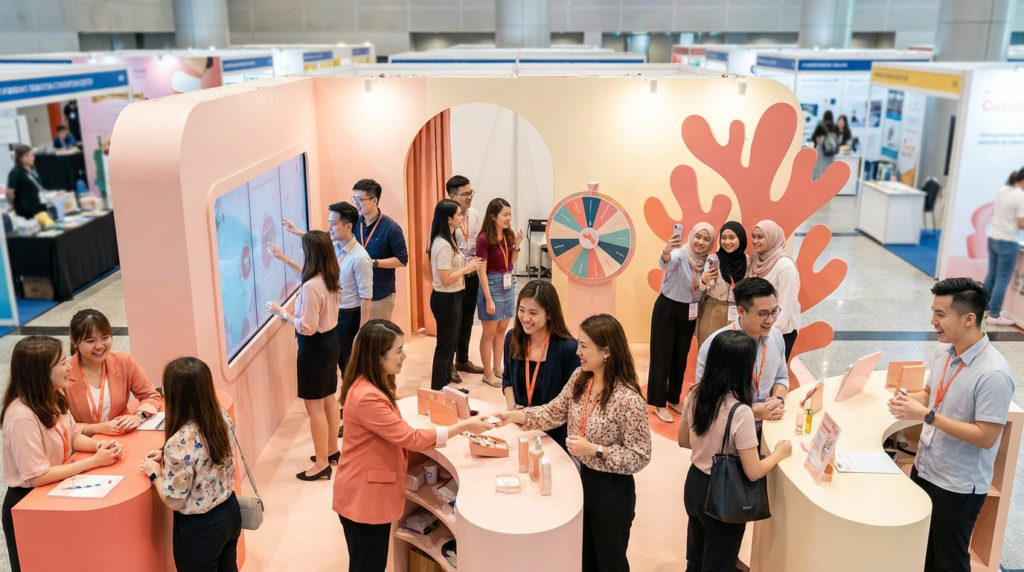
Attention gets you noticed. Engagement keeps people on your stand long enough to matter. This is where interactive exhibition ideas move a booth from “looked nice” to “could not get near it”:
- Hands-on demos. People remember what they do far more than what they are told, so let them hold the product or drive the software themselves.
- Touchscreens and AR. Touch-screen walls and augmented-reality try-ons turn a passive glance into an active minute or two.
- Gamification. A spin-to-win, a leaderboard or a quick quiz with a small reward gives people a reason to stop and a reason to stay.
- Shareable moments. A photo or AR moment visitors actually want to share extends your reach beyond the people physically present.
The hidden benefit is social proof. A crowd is the most powerful magnet on any show floor, because foot traffic follows foot traffic. Three people at your demo will draw a fourth and a fifth who simply want to see what they are missing. The interaction does not have to end at the doors, either. Partnering with a capable virtual event agency lets you livestream a demo or panel from your stand to a remote audience, turning a physical booth into a hybrid touchpoint without losing the in-person energy.
That said, the most powerful interactive element is still a well-briefed person. Technology opens the conversation; your team carries it. Brief staff to stand at the edge of the stand rather than the back, to lead with a genuine question instead of a pitch, and to rotate breaks so the booth never looks abandoned. A confident opening line and an obvious reason to step in will out-convert the slickest screen if the person beside it knows what to do with the attention it earns.
Turning Foot Traffic Into Lead Capture
A packed stand that produces no follow-ups is a party, not a marketing investment. The bridge between the two is lead capture that feels effortless:
- Make the next step obvious. Decide before the show what you want a visitor to do, then design for it. If the goal is a demo booking, the booking should be one tap away.
- Keep forms short. Three fields, not ten. Capture name, company and the one thing they cared about, and let your team note the rest.
- Use badge scanning or a pre-filled QR code where the organiser provides it, so capturing details never interrupts the conversation.
- Plan the follow-up before build-up, not after teardown.
This end-to-end thinking, from first glance to qualified lead, is what a disciplined event planner in Singapore builds into the brief from day one rather than bolting on at the end.
It also pays to grade leads as you collect them. A simple hot, warm or cold tag against each scan, plus a one-line note on what the visitor asked about, lets your sales team prioritise the moment the show ends. Speed then does the rest. Interest cools fast after an exhibition, so a follow-up within forty-eight hours, referencing the exact conversation, consistently outperforms a generic mailer sent a week later when the visitor has forgotten which of forty booths you were.
Designing for the Singapore Context
Exhibition booth design in Singapore comes with local realities that a generic playbook will miss. Here is what to confirm early:
| What to check | Why it matters in Singapore |
| Build height and rigging limits | Singapore EXPO, Suntec, Sands Expo and Marina Bay Sands each cap height and rigging. |
| Fire-safety and structural approvals | Submissions must clear in advance, or your design gets cut down. |
| Build-up and teardown windows | Tight venue slots dictate your entire build schedule. |
| Humidity and air-conditioning | These affect adhesives, printed graphics and timber finishes. |
| Multilingual audience | Messaging often needs to land across languages. |
| Green procurement | Stat-board and government shows increasingly favour reusable, modular builds. |
A local event organizer in Singapore will know each venue’s loading-bay timings, height caps and approval paperwork, and will plan the build around them so there are no surprises on site. Designing with sustainability in mind is not just good citizenship here; increasingly, it is what wins the tender.
Two practical details round out the local picture. First, never assume power and connectivity. Venue electrical and internet provisioning is ordered ahead of time and charged accordingly, so any interactive screen, payment terminal or livestream depends on confirming these well before move-in. Second, read the audience. Singapore exhibition-goers respond strongly to a clear value exchange, whether that is a useful demo, a quick win or a worthwhile giveaway, and a visible queue can work in your favour as a signal of something worth waiting for. Timing helps too: aligning your build and reveal with the busiest hours of the show, rather than the quiet first morning, concentrates your foot traffic when it counts.
Exhibition Booth Design Mistakes to Avoid
A quick checklist of the errors that quietly sink otherwise strong stands:
- Too much copy. If the wall reads like a brochure, nobody reads it.
- No lighting plan. Relying on ambient hall lighting leaves your stand flat and forgettable.
- Hiding the team. Staff buried behind counters or glued to their phones signal “do not approach.”
- Forgetting storage. Bags and stock spilling into view break the spell instantly.
- Leaving lead capture to chance. No system means no data, and no data means no ROI.
- Underestimating build and teardown. A good event organizer in Singapore builds buffer into the schedule so quality holds when the clock is against you.
Bringing It All Together
A stand that wins foot traffic is not an accident of budget or luck. It is the product of clear thinking: read the hall, design an open layout, win the three-second glance, engage with something hands-on, and capture leads without friction, all tuned to Singapore’s venues, climate and audiences. Decoration is the last 10 percent. The first 90 percent is strategy.
Plan Your Next Exhibition With HYDSE
If you would rather not gamble your booth budget on guesswork, this is precisely what HYDSE does. As a full-service event company in Singapore since 2014, HYDSE brings in-house design, multimedia and software teams under one roof, including proprietary interactive exhibition hardware built specifically to draw and hold a crowd. The team is BizSafe Level 3 certified and has delivered exhibitions, roadshows and launch ceremonies for government ministries, stat boards and global brands such as Unilever and Estée Lauder.
From concept and booth layout to fabrication, interactive content and on-the-day execution, HYDSE handles the full build. As a virtual event agency as well, the team can extend your stand into livestreamed demos and hybrid experiences that reach audiences far beyond the show floor.
Ready to turn your next exhibition into a stand people actually stop at? Get a quote from HYDSE and start with a conversation about your goals.