
A groundbreaking ceremony marks far more than the start of construction. For organisations preparing to build a new headquarters, community facility, technology hub, landmark development or major infrastructure project, the ceremony represents the moment when plans begin to become something tangible.
However, a successful groundbreaking ceremony involves much more than placing a few ceremonial shovels into the soil. Depending on the scale of the event, planning can involve guest registration, VIP protocol, temporary infrastructure, staging, multimedia, launch mechanisms, photography, technical production and detailed movement around an active construction site.
In Singapore, those requirements can become particularly complex because groundbreaking events are often held outdoors and at sites that were never designed to function as event venues.
As an event company in Singapore, We planned and produced groundbreaking ceremonies across different formats and scales. Our portfolio includes the traditional Founders’ Memorial groundbreaking, the community-focused Joo Chiat Community Club groundbreaking and the large-scale NS Square Groundbreaking Ceremony.
This guide explains what happens during a groundbreaking ceremony, how one is planned, the logistics involved and the different ways organisations can create a meaningful ceremonial moment.
What Is a Groundbreaking Ceremony?
A groundbreaking ceremony is a formal event held to mark the beginning of construction or development works for a new project.
Traditionally, selected representatives use ceremonial shovels to turn the first soil at the project site. However, modern groundbreaking ceremonies can involve much more elaborate activations, including LED displays, multimedia sequences, customised structures and interactive mechanisms.
The purpose remains symbolic.
A groundbreaking ceremony provides an opportunity to acknowledge the significance of the development, recognise the people involved and communicate what the completed project will eventually represent.
Groundbreaking ceremonies may be organised for:
- Corporate headquarters
- Regional offices
- Data centres
- Technology facilities
- Innovation hubs
- R&D facilities
- Community facilities
- Cultural landmarks
- Educational developments
- Healthcare facilities
- Industrial developments
- Infrastructure projects
The format should therefore reflect the project rather than follow one standard template.
How Is a Groundbreaking Ceremony Different From an Opening Ceremony?
A groundbreaking ceremony generally takes place at the beginning of construction. Meanwhile, an opening ceremony usually occurs once the building or facility has been completed and is ready for operation.
| Ceremony | Typical Stage | Purpose |
|---|---|---|
| Groundbreaking ceremony | Beginning of construction | Marks the official start of a development |
| Topping-out ceremony | Structural milestone | Marks completion of the highest structural point |
| Opening ceremony | Project completion | Officially opens the completed facility |
| Launch ceremony | Varies | Introduces a development, initiative, organisation or offering |
Although these events can contain similar ceremonial elements, the milestone being recognised is different.
HYDSE Portfolio: Three Groundbreaking Formats
HYDSE’s experience demonstrates how different one groundbreaking ceremony can be from another.
The Founders’ Memorial used a more traditional groundbreaking concept centred around a themed soil dig.
For the Joo Chiat Community Club groundbreaking, the event required a larger LED launch mechanism that could accommodate a bigger group of VIP participants.
NS Square, meanwhile, involved a large-scale groundbreaking ceremony with a customised activation and considerably more event infrastructure.
This range is important because the ceremonial mechanism should be designed around the scale, audience and meaning of the project, rather than selected simply because it has been used before.
What Happens in a Groundbreaking Ceremony?
A typical groundbreaking ceremony follows a structured sequence.
Usually, guests arrive and register before being directed to the event area. VIPs may follow a separate arrival process. Once everyone is seated, the official programme begins with opening remarks, project presentations and speeches.
The ceremonial groundbreaking moment then takes place, followed by official photography and, in some cases, networking, refreshments, exhibitions or a site presentation.
A typical sequence may look like this:
- Guest registration
- General guest arrival
- VIP arrival and reception
- Guests are seated
- Emcee opening
- Welcome remarks
- Project introduction or multimedia presentation
- Speeches
- VIPs proceed to the groundbreaking area
- Ceremonial activation
- Official photography
- Reception, networking or project showcase
- Guest departure
However, this sequence can change according to the event.
For example, a smaller corporate groundbreaking ceremony may be completed relatively quickly. Meanwhile, a high-profile ceremony involving several senior representatives may require additional holding time, security arrangements, media coordination and movement between different event zones.
HYDSE Example: NS Square Groundbreaking Ceremony
The NS Square Groundbreaking Ceremony provides a useful example of what a large-scale groundbreaking can involve.
The event was held at the NS Square construction site and attended by approximately 400 guests. HYDSE was responsible for bringing the event environment to life despite the challenges presented by an active construction location. HYDSE also managed pre-event and event-day registration.
For the ceremonial moment itself, HYDSE was responsible for the conceptualisation and design build of the launch mechanism.
The sequence was created so that the VIP guests could activate the mechanism, triggering the larger reveal.
In other words, the groundbreaking ceremony was not treated simply as a speech followed by a photograph. The ceremonial action itself was designed as part of the overall event experience.
Official MINDEF coverage also confirms that the groundbreaking ceremony brought together senior representatives from government, defence and other stakeholder groups.
This illustrates an important planning principle: the ceremonial moment needs to work together with the programme, VIP movement, technical cues and photography.
Groundbreaking Ceremony Programme: Sample Event Flow
There is no fixed duration for a groundbreaking ceremony.
However, a focused programme can often be structured within approximately 60 to 90 minutes.
| Time | Example Programme |
|---|---|
| 9:00am | Guest arrival and registration |
| 9:20am | Guests seated |
| 9:25am | VIP arrival |
| 9:30am | Emcee opening |
| 9:35am | Welcome address |
| 9:45am | Project presentation or video |
| 9:55am | Guest-of-Honour speech |
| 10:05am | VIP movement to ceremonial area |
| 10:10am | Groundbreaking ceremony activation |
| 10:15am | Official photography |
| 10:25am | Reception, networking or project showcase |
| 10:45am | Programme concludes |
This should be treated as a planning reference rather than a fixed formula.
For instance, an event involving several speakers may require a longer stage programme. Likewise, if the ceremonial area is located away from the main seating area, additional transition time should be built into the schedule.
Therefore, an event planner in Singapore should develop the programme together with the site plan, guest movement and technical sequence.
Doing so helps prevent a common problem: a programme that looks efficient on paper but does not account for how long hundreds of people actually need to move from one area to another.
Who Attends a Groundbreaking Ceremony?
A groundbreaking ceremony may bring together many of the people responsible for funding, designing, developing, constructing or supporting a project.
Depending on the development, attendees can include:
- Board members
- C-suite executives
- Senior management
- Investors
- Developers
- Architects
- Contractors
- Consultants
- Business partners
- Employees
- Government representatives
- Community representatives
- Media
- Key stakeholders
For corporate projects, the guest list may focus on executives, investors, project partners and employees.
For public-facing developments, however, the ceremony may also involve ministers, community representatives, statutory boards or members of the public.
HYDSE Portfolio: Senior Stakeholders at NS Square
The NS Square Groundbreaking Ceremony involved a particularly high-profile guest list.
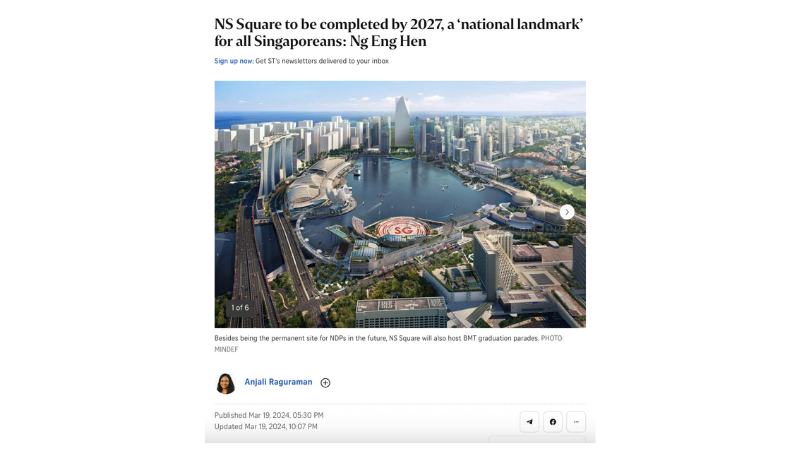
Official MINDEF information identifies attendees including Minister for Defence Dr Ng Eng Hen, Senior Ministers of State Mr Heng Chee How and Mr Zaqy Mohamad, Minister of State Dr Muhammad Faishal Ibrahim and other senior stakeholders.
The ceremony also received media coverage from The Straits Times, which reported on the groundbreaking and the development of NS Square as a future national landmark.
Therefore, event planning had to consider more than overall capacity. The programme also needed to support the movement, positioning and participation of senior guests, while ensuring the groundbreaking moment was suitable for both invited attendees and media coverage.
HYDSE Portfolio: Founders’ Memorial
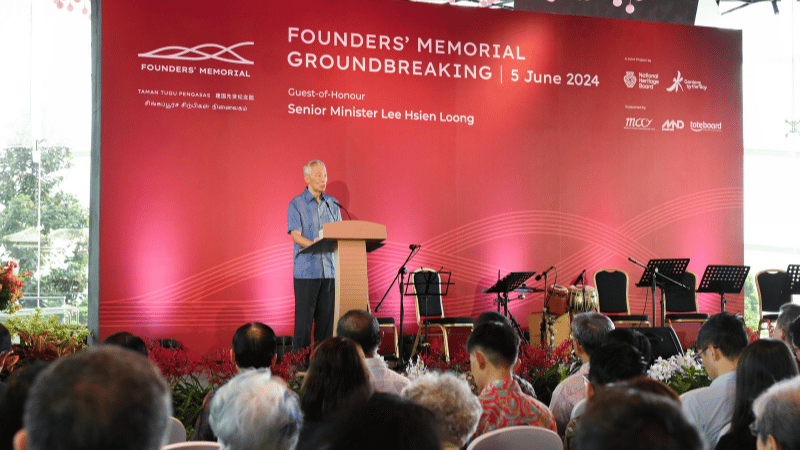
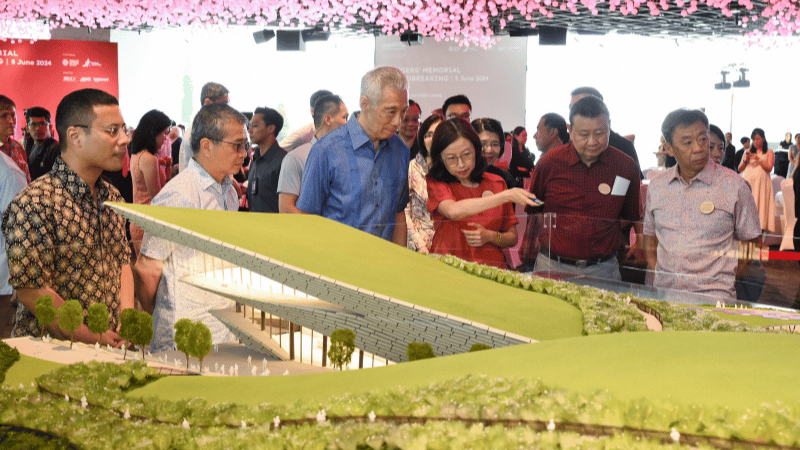
The Founders’ Memorial groundbreaking was also a high-profile occasion, graced by Senior Minister Lee Hsien Loong.
The official Founders’ Memorial groundbreaking was held on 5 June 2024, marking the start of development for the national memorial.
For a groundbreaking ceremony with senior guests, protocol considerations become part of event planning from the beginning rather than something added shortly before event day.
Groundbreaking Ceremonies for Corporate and MNC Projects
Groundbreaking ceremonies are not limited to public-sector developments.
For corporations and multinational companies, the start of a major development can represent an important business milestone that deserves to be recognised.
This is particularly relevant for organisations in the finance and technology sectors.
A corporate groundbreaking ceremony could mark the beginning of a new:
- Regional headquarters
- Corporate campus
- Technology centre
- Data centre
- Innovation hub
- R&D facility
- Operations centre
- Sustainable office development
- Manufacturing facility
- Training centre
- Regional expansion project
For a technology company, for example, a new data centre or innovation facility may represent a significant investment in Singapore.
Therefore, the groundbreaking ceremony can communicate innovation, growth and long-term commitment to the market.
Likewise, a financial institution developing a regional headquarters may use its groundbreaking ceremony to bring together executives, investors, project partners and strategic stakeholders.
The event can therefore become both a ceremonial milestone and a corporate communications opportunity.
For companies choosing a Singapore event company for such a project, it is useful to consider whether the team can handle formal stakeholder requirements while also developing an experience that reflects the organisation’s brand.
The ceremonial concept for a finance organisation does not need to look like one designed for a technology company. Similarly, an innovation hub does not have to use the same groundbreaking format as a conventional office development.
The strongest concept starts with what the new development represents.
Groundbreaking Ceremony Ideas
The traditional shovel-and-soil arrangement remains relevant. However, it is only one way to create a groundbreaking ceremony.
Depending on the project, organisations can consider:
- Traditional ceremonial shovels
- Branded soil installations
- Interactive buttons
- Custom-built mechanisms
- LED activations
- Multimedia sequences
- Digital countdowns
- Mechanical reveals
- Light-based activations
- Architectural model reveals
- Symbolic structures
- Group activation moments
The right idea should be easy for guests to understand and easy for VIPs to perform.
More importantly, it should connect logically with the development.
The same principle applies when developing launches. A ceremonial action becomes much stronger when it represents the project rather than being added solely for visual impact.
HYDSE Example: Founders’ Memorial Traditional Soil Dig
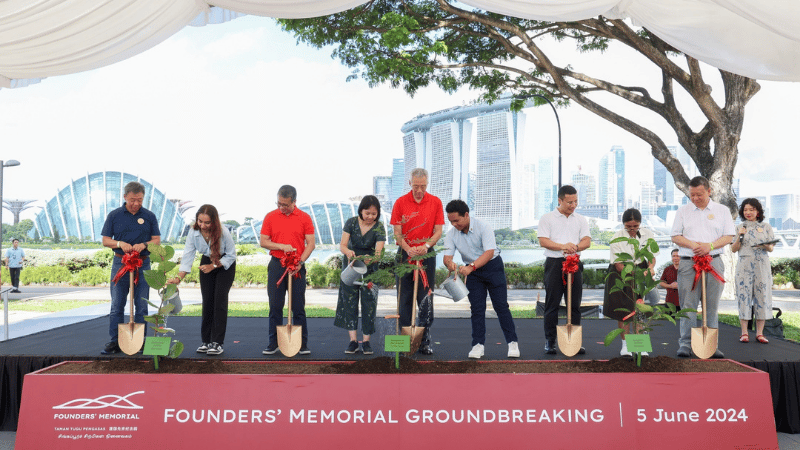
The Founders’ Memorial provides an example of a more traditional groundbreaking ceremony.
HYDSE designed the event, including the themed soil dig used for the ceremonial groundbreaking moment.
Rather than replacing the familiar groundbreaking tradition, the concept adapted it to the context of the project.
This demonstrates that a ceremony does not need complex technology to feel considered. Instead, the execution, visual treatment and symbolism can make a traditional mechanism distinctive.
HYDSE Example: NS Square Custom Reveal
NS Square shows a very different approach.
For this large-scale groundbreaking ceremony, the ceremonial sequence involved VIP guests activating a button, which triggered the event’s larger reveal.
The concept was therefore closer to an integrated launch mechanism than a conventional shovel ceremony.
The action also created a strong focal point for both the physical audience and event photography.
HYDSE Example: Joo Chiat Community Club LED Activation
The Joo Chiat Community Club groundbreaking required another format.
Because it was a community event with a larger group of VIP guests participating in the launch moment, HYDSE developed a large LED launch mechanism that could accommodate the group.
This highlights an important consideration when developing groundbreaking ceremony ideas: participation numbers matter.
An activation designed for three people may not work for ten.
Therefore, the mechanism should be designed around the actual guest formation rather than forcing people into a format that was created for a smaller event.
Groundbreaking Event Logistics Guide
The ceremonial moment may last only a few minutes. However, the logistics required to create it can begin months earlier.
Unlike a ballroom event, a groundbreaking ceremony may happen on an undeveloped or active construction site with limited existing infrastructure.
Therefore, logistics need to be considered from the earliest planning stage.
1. Conduct a Site Recce
The planning team should assess:
- Vehicle access
- Guest drop-off locations
- Pedestrian routes
- Ground conditions
- Construction activity
- Power availability
- Emergency access
- Existing shelters
- Drainage
- Noise
- Sun direction
- Accessible routes
- Loading points
- Photography sightlines
The site recce often determines what is realistically possible.
2. Plan Temporary Infrastructure
A groundbreaking ceremony may require an entire temporary event environment.
That could include:
- Tentage
- Flooring
- Stage structures
- Registration counters
- Seating
- Holding rooms
- Cooling equipment
- Electrical distribution
- LED screens
- Audio systems
- Lighting
- Catering areas
- Toilets
- Signage
Singapore’s Building and Construction Authority lists tentage, stages and other structures among the types of temporary buildings that may fall under its regulatory framework.
Organisers should therefore check the relevant temporary building application requirements early in the planning process.
3. Plan Power and Technical Requirements
Construction sites may not provide the same electrical infrastructure as conventional event venues.
Requirements may include power for:
- LED walls
- Audio
- Lighting
- Multimedia
- Registration equipment
- Air-cooling systems
- Launch mechanisms
- Catering
- Production equipment
Backup arrangements should also be considered for critical systems.
4. Design Guest Movement
Guest movement should be mapped before temporary structures are finalised.
Attendees may need to move between:
registration → seating → groundbreaking area → photography → reception.
VIPs may have a completely separate flow.
Therefore, entrances, exits and transition paths need to accommodate the expected crowd comfortably.
HYDSE Example: Building the NS Square Event Environment From the Ground Up
NS Square is one of the clearest examples of why groundbreaking event logistics need their own planning workstream.
The groundbreaking ceremony took place at the construction site itself. The team had to bring the event to life from scratch while navigating the challenges created by the dynamic environment.
This included establishing the event infrastructure required to make the environment suitable and comfortable for guests.
HYDSE also handled pre-event and actual-day registration for the approximately 400 attendees.
Therefore, the event involved much more than building a ceremonial mechanism. Site infrastructure, guest comfort, registration and production all had to function together.
For organisations evaluating an events management company Singapore can support for a construction-site event, this operational capability can be just as important as the creative concept.
Planning a Groundbreaking Ceremony in Singapore
Singapore’s climate, site conditions and operating environment create several additional considerations for an outdoor groundbreaking ceremony.
Plan for Wet Weather
Weather contingency should be developed together with the original event concept.
Consider:
- Covered seating
- Covered VIP routes
- Tentage
- Umbrellas
- Drainage
- Non-slip flooring
- Protection for technical equipment
- Cooling and ventilation
- Alternative programme sequences
The planning team should also decide what happens to the groundbreaking activation if conditions become unsuitable.
For example, if the ceremonial moment relies on electrical or multimedia equipment, a clear wet-weather procedure is particularly important.
Think About the Actual Ground Conditions
A groundbreaking ceremony often happens before the site is fully developed.
Therefore, guests may encounter uneven surfaces, construction access roads or areas unsuitable for normal event footwear.
The team should consider flooring, accessibility and the distance guests need to walk.
Plan Around the Location, Not Just the Programme
The site may dictate how the programme needs to work.
For example, a project may require guests to move between two venues. Another may involve a wide ceremonial space because many people need to participate.
Consequently, the physical environment should inform the event format.
HYDSE Example: Joo Chiat Community Club
The Joo Chiat Community Club groundbreaking is an example of a ceremony where the nature of the audience influenced the activation.
Because a larger group of VIP guests needed to participate, HYDSE developed an LED launch mechanism designed to accommodate the group.
Therefore, the site layout, participant numbers and ceremonial mechanism had to be considered together.
HYDSE Example: Founders’ Memorial Across Two Locations
Founders’ Memorial presented a different logistical requirement.
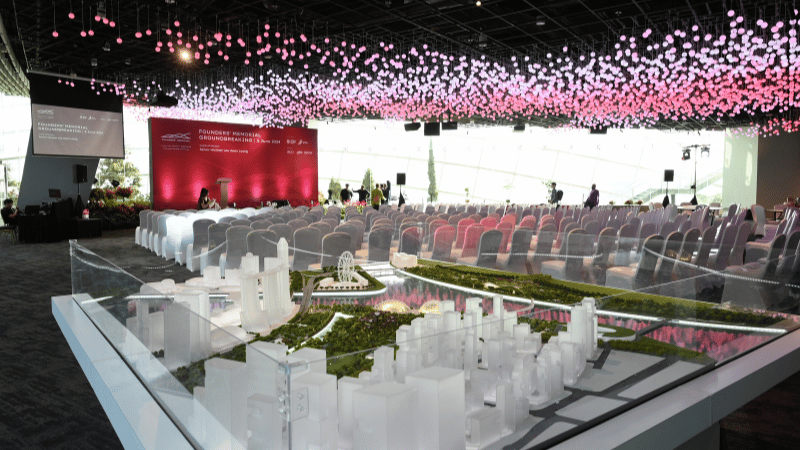
The groundbreaking ceremony and the subsequent programme involved two locations, with the groundbreaking at Bay East Gardens and the ceremony programme at Gardens by the Bay.
As a result, precise coordination was required between the two environments.
This is a good example of why planning a groundbreaking ceremony cannot stop at the ceremonial zone itself.
The full guest journey matters.
If an organisation intends to continue its programme with a corporate presentation, stakeholder session or discussion elsewhere, it can also consider suitable meeting venues Singapore offers for the next stage of the event.
VIP Protocol and Guest Experience
A groundbreaking ceremony involving senior executives, ministers or distinguished guests requires particularly careful movement planning.
Key considerations include:
- Vehicle arrival times
- Drop-off points
- Greeting parties
- Holding rooms
- Escort routes
- Seating arrangements
- Speaking order
- Stage movement
- Ceremonial positions
- Photo positions
- Departure arrangements
The run sheet should make every transition clear.
Moreover, rehearsals should account for what VIP participants physically need to do during the ceremonial activation.
They should know:
- When to move
- Where to stand
- What action to perform
- When the activation begins
- Where photographers are located
- When the photo hold ends
Therefore, VIP protocol is not separate from event production. The two need to work together.
HYDSE Example: Founders’ Memorial VIP Coordination
The Founders’ Memorial groundbreaking was graced by Senior Minister Lee Hsien Loong.
In addition, the event required coordination across two locations.
This meant the team had to account not only for what happened during the ceremonial groundbreaking, but also how the programme and guests transitioned between locations.
For high-profile groundbreaking ceremonies, this type of precise movement planning can be just as important as the stage programme itself.
An experienced event planner in Singapore therefore needs to think through the entire VIP journey, from arrival to departure.
Creative and Technical Production for a Groundbreaking Ceremony
Creative and technical production determine how the concept becomes a physical experience.
Typical requirements can include:
- Event branding
- Stage design
- LED walls
- Audio
- Lighting
- Multimedia
- Video production
- Signage
- Photography
- Videography
- Registration systems
- Ceremonial mechanisms
However, these elements should not operate independently.
For example, the mechanism designer needs to understand how many VIPs will participate. The multimedia team needs to know the activation cue. The technical team needs to coordinate sound, screen and lighting changes. Meanwhile, the event team needs to ensure the participants are in position at precisely the right moment.
What HYDSE Does: In-House Creative, Multimedia and Event Management
We have an in-house design team, video and multimedia production unit and event management unit working together across its projects.
That integrated capability is especially relevant to groundbreaking ceremonies because the creative concept and technical execution are closely connected.
The three groundbreaking examples demonstrate this in different ways:
| HYDSE Project | Creative / Technical Approach |
|---|---|
| Founders’ Memorial | Designed traditional themed soil-dig ceremony |
| Joo Chiat Community Club | Large LED launch mechanism designed for group participation |
| NS Square | Custom activation and reveal integrated into a large-scale event environment |
Therefore, organisations selecting an event company in Singapore should consider not only whether an agency can propose a creative idea, but also how that idea will be designed, produced, rehearsed and operated on the day itself.
Groundbreaking Ceremony Checklist
A practical checklist can help teams identify requirements before production begins.
Project and Purpose
- Define what milestone the groundbreaking ceremony marks
- Identify the key message
- Determine the target audience
- Decide on the desired tone
- Confirm whether media coverage is expected
Site and Logistics
- Conduct site recce
- Confirm event footprint
- Review construction activity
- Plan vehicle access
- Map guest routes
- Check accessibility
- Determine tentage requirements
- Confirm power requirements
- Assess ground conditions
- Create wet-weather plan
Guests and VIPs
- Build invitation list
- Confirm VIP attendance
- Prepare seating plan
- Develop registration process
- Plan arrival routes
- Confirm holding areas
- Prepare escort arrangements
Programme
- Confirm emcee
- Confirm speakers
- Prepare speeches
- Develop project presentation
- Finalise ceremonial sequence
- Confirm photography arrangements
- Build detailed event rundown
- Schedule rehearsals
Production
- Stage
- Flooring
- Tentage
- Seating
- Branding
- Audio
- Lighting
- LED screens
- Multimedia
- Photography
- Videography
- Launch mechanism
- Registration systems
Contingency
- Wet weather
- Technical failure
- Power failure
- Delayed VIP
- Site-access changes
- Medical response
- Programme delay
If part of the event includes a separate briefing or stakeholder discussion, organisers may also need to decide where to have meetings in Singapore as part of the wider programme.
Common Groundbreaking Ceremony Mistakes
Even a short groundbreaking ceremony can involve a large number of moving parts.
Several mistakes are worth avoiding.
Treating the Ceremony as Only a Photo Opportunity
Photography is important. However, the event should still explain why the development matters.
Guests should understand what they are witnessing and what the future project represents.
Choosing the Activation Before Understanding the Site
A concept can look impressive during design development but prove impractical at the actual location.
Therefore, the site recce should happen early.
Overcomplicating the Groundbreaking Moment
VIPs should be able to understand the ceremonial action immediately.
If the activation is too complicated, the visual moment can become confusing.
Underestimating Guest Comfort
Construction locations may involve heat, uneven ground, longer walking distances or limited shelter.
Therefore, guest comfort should form part of logistics planning.
Failing to Rehearse the Photography
Everyone participating in the ceremony should know where to stand and where to look.
Otherwise, the defining image of the groundbreaking ceremony may not capture the moment effectively.
Treating Wet Weather as a Last-Minute Problem
A groundbreaking ceremony in Singapore should have a contingency plan before event day.
The production team, client and VIP protocol team should all know what changes if conditions deteriorate.
HYDSE Groundbreaking Ceremony Portfolio at a Glance
HYDSE’s projects show that there is no single formula for a groundbreaking ceremony.
| Project | Type | What HYDSE Did |
|---|---|---|
| Founders’ Memorial | Traditional ceremonial format | Designed the event and themed soil-dig groundbreaking moment, with coordination across multiple locations |
| Joo Chiat Community Club | Community-focused groundbreaking | Developed a large LED mechanism suitable for a bigger group of VIP participants |
| NS Square | Large-scale, high-profile groundbreaking | Developed the launch mechanism, supported major site setup, handled registration and helped create the event environment at an active construction site |
This portfolio range matters because different organisations require different solutions.
A traditional shovel-and-soil ceremony may be exactly right for one development.
Another project may require a digital or multimedia-led reveal.
Meanwhile, a large corporate or national development may need temporary infrastructure, a substantial technical production setup and detailed stakeholder coordination.
How HYDSE Plans Groundbreaking Ceremonies
A strong groundbreaking ceremony starts with the purpose of the development.
The equipment comes later.
Step 1: Understand the Project
First, determine what the development represents.
Is it a new headquarters? A community facility? A data centre? An innovation hub? A landmark development?
This helps establish the tone and creative direction.
Step 2: Understand the Site
Next, the event team studies the location, guest access, ground conditions, power, construction activities and event footprint.
Step 3: Develop the Groundbreaking Concept
The ceremonial moment can then be designed around:
- Project purpose
- Brand
- Audience
- Number of VIP participants
- Site limitations
- Desired visual impact
Step 4: Design and Produce the Experience
Branding, staging, multimedia, event logistics and the launch mechanism need to work as one system.
Step 5: Rehearse the Ceremony
Technical cues, VIP movements, speeches, photography positions and the activation itself should be rehearsed.
Step 6: Manage Actual-Day Execution
Finally, the event team coordinates guests, stakeholders, vendors, speakers, technical crews and the live programme.
This is where having an experienced Singapore event company becomes especially relevant. Groundbreaking ceremonies often combine ceremonial protocol, technical production and unconventional site conditions within a relatively short live programme.
Groundbreaking Ceremony FAQs
What happens in a groundbreaking ceremony?
A groundbreaking ceremony typically includes guest registration, opening remarks, speeches, a presentation about the development, the ceremonial groundbreaking action, official photography and a reception or networking segment. However, the exact programme depends on the scale and purpose of the project.
How long does a groundbreaking ceremony last?
Many groundbreaking ceremonies can be completed within approximately 60 to 90 minutes. However, larger programmes may take longer if they include performances, exhibitions, media activity, networking or multiple stakeholder sessions.
Does a groundbreaking ceremony need ceremonial shovels?
No. Ceremonial shovels are traditional, but organisations can also use interactive mechanisms, LED displays, multimedia reveals or other symbolic activations.
Who should attend a groundbreaking ceremony?
Guests may include executives, investors, developers, government representatives, architects, contractors, employees, project partners, community stakeholders and media.
What should guests wear to a groundbreaking ceremony?
Business or business-formal attire is common. However, organisers should consider the site conditions and inform guests if suitable footwear or other safety requirements apply.
What is a groundbreaking ceremony programme?
A groundbreaking ceremony programme is the event rundown covering guest arrival, registration, speeches, project presentations, the ceremonial activation, photography and any subsequent networking or reception.
How do you plan a groundbreaking ceremony at a construction site?
Start with a detailed site recce. Then plan access, temporary infrastructure, power, flooring, tentage, guest movement, registration, safety, technical production and weather contingency before finalising the event programme.
What happens if it rains during a groundbreaking ceremony?
The organiser should already have a wet-weather plan covering shelter, VIP routes, guest movement, technical equipment and any changes required to the ceremonial activation.
What is the difference between a groundbreaking ceremony and an opening ceremony?
A groundbreaking ceremony marks the beginning of construction or development. An opening ceremony usually takes place after the development has been completed and is ready for use.
Can finance and technology companies organise groundbreaking ceremonies?
Yes. A groundbreaking ceremony can mark a new regional headquarters, data centre, innovation hub, research facility, corporate campus or other significant investment by a finance or technology organisation.
Planning a Groundbreaking Ceremony in Singapore?
A memorable groundbreaking ceremony is not necessarily the ceremony with the largest stage or most complicated technology.
Instead, the strongest events connect the meaning of the development with the ceremonial moment, guest experience and physical environment.
HYDSE’s experience shows how this can take different forms.
The Founders’ Memorial demonstrates how a traditional groundbreaking concept can be deliberately designed around symbolism and protocol.
Joo Chiat Community Club shows how an interactive mechanism can be adapted for a larger group of participants.
Meanwhile, NS Square demonstrates the additional production and logistical requirements involved when a large-scale groundbreaking ceremony is held at an active construction site.
We are an integrated team structure, including in-house design, video and multimedia production and event management capabilities.
For corporate and multinational organisations, including companies in the finance and technology sectors, those capabilities can also be applied to new headquarters, data centres, innovation facilities, R&D hubs and other major developments.
For organisations looking for an events management company Singapore teams can work with from concept development through production and actual-day management, HYDSE can help turn an important project milestone into a carefully planned event experience.
A groundbreaking ceremony may mark the first physical step of a much larger development. With the right concept and execution, it can also become the first memorable story that development tells.